


Foam liners are widely used in bottle and container packaging, but choosing the right material is not simply a matter of comparing their softness or price.
PE foam and PS foam have different material characteristics and are commonly used in different types of closure systems. EPE foam, a type of expanded polyethylene foam, is frequently used as an inner liner for bottle caps. PS foam, on the other hand, is commonly used as the base material for pressure-sensitive liners.
For packaging buyers, understanding this distinction is a practical starting point when selecting a liner.
PE Foam and PS Foam: Understanding the Difference
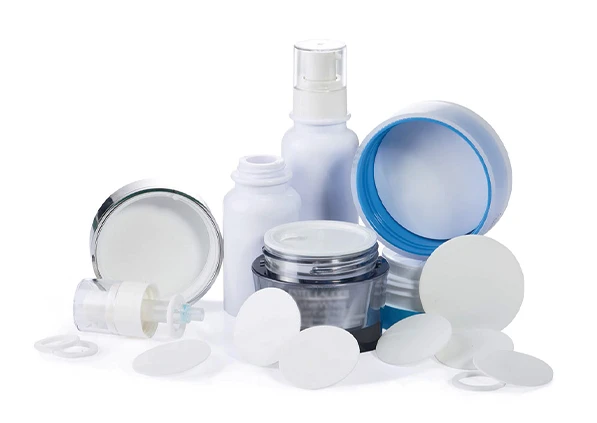
PE Foam (Expanded Polyethylene Foam)
PE foam liners are mainly made from EPE foam sheets. EPE is a lightweight material with a closed-cell structure. Its cushioning properties and moderate softness make it suitable for applications where a liner is placed inside a bottle cap.
In packaging, EPE foam liners are commonly used to provide a cushioning layer between the cap and the container opening. They can be converted into different diameters, thicknesses, and shapes to match individual cap designs.
Their relatively smooth appearance and moisture-resistant characteristics are also useful considerations when selecting a material for packaging applications.

PS Foam (Expanded Polystyrene Foam)
PS foam liners are made from expanded polystyrene foam sheets. The material is lightweight and can be processed into different shapes and sizes.
One common application is as the foam base of pressure-sensitive liners. In this construction, the PS foam is combined with a pressure-sensitive adhesive layer so that the liner can adhere to the container rim when the cap is tightened.
The surface of untreated PS foam is relatively rough and is not suitable for direct printing. Depending on the product design, different films or paper materials can be laminated onto the surface to provide a more suitable finish.
PE Foam vs. PS Foam: Which One Should You Choose?
The most important difference for packaging buyers is their common application.
| Comparison | PE Foam (EPE) | PS Foam |
|---|---|---|
| Main material | Expanded polyethylene | Expanded polystyrene |
| Common application | Inner liner for bottle caps | Base material for pressure-sensitive liners |
| Material characteristics | Lightweight, cushioning, moderate softness | Lightweight, easy to process |
| Surface | Generally smooth | Relatively rough without surface treatment |
| Processing | Die-cutting | Die-cutting |
| Customization | Different shapes, diameters, and thicknesses | Different shapes and diameters |
| Surface options | Can be laminated according to requirements | Can be laminated with film or paper |
| Printing | Depends on the selected surface structure | Single-color printing can be supported with a suitable surface treatment |
Neither material is universally better. The suitable choice depends on how the liner is expected to work inside the closure.
- If the main requirement is a cushioning liner placed inside a bottle cap, EPE foam is a common option to consider.
- If the packaging design requires a pressure-sensitive liner that adheres to the container rim when the cap is tightened, PS foam can be considered as the foam base material.
It is important to distinguish the foam material from the complete liner construction. PS foam alone is not necessarily pressure-sensitive; the appropriate adhesive layer and other components are needed to create a functional pressure-sensitive liner.
When Is PE Foam a Suitable Choice?
EPE foam is commonly used for bottle cap liners because of its cushioning properties and lightweight structure.
When the cap is tightened, the liner sits between the cap and the container opening. Its thickness and physical properties should be suitable for the available space inside the cap and the dimensions of the container rim.
PE foam liners can be customized according to the packaging design, including:
Different diameters to match the cap size
Customized thicknesses
Round or other die-cut shapes
Laminated surface options when required
For buyers developing a new cap or changing an existing closure design, it is helpful to check the internal cap dimensions and container opening before confirming the liner specification.
When Is PS Foam Used for Pressure-Sensitive Liners?
PS foam is commonly used as the foam base in pressure-sensitive liner constructions.
Unlike a conventional foam liner that simply sits inside the cap, a pressure-sensitive liner is designed to adhere to the container rim when the cap is tightened.

The adhesive layer plays an important role in this application. Its compatibility with the container surface, together with the liner dimensions and cap design, should be evaluated before mass production.
PS foam also offers flexibility in surface finishing. Since the untreated foam surface is relatively rough, it can be laminated with different films or paper materials according to the required appearance and product design.
For packaging projects that require printed surfaces, a suitable laminated structure can also support single-color printing.
Customization: Shape, Diameter, Lamination, and Printing
Both PE foam and PS foam liners can be processed by die-cutting. This allows buyers to request different shapes and diameters according to their cap and container designs.
Customization can include:
Shape and diameter
Round liners are common, but other shapes can be considered depending on the closure design. The required diameter should be confirmed using the actual cap and container dimensions.
01
Thickness
The required thickness depends on the available space inside the cap, the container rim, and the intended application. Buyers should confirm the specification through sample fitting rather than selecting thickness based on material type alone.
02
Surface lamination
Different films or paper materials can be laminated onto the foam according to the product requirements. The selected surface material should be confirmed before production.
03
Printing
Single-color printing can be supported with a suitable surface structure. Buyers should provide their artwork and confirm the printing requirements when requesting samples.
04
Not every combination of foam, film, adhesive, and printing process is automatically suitable. The final construction should be confirmed with the supplier.
What Information Should You Provide When Requesting a Foam Liner?
To help a supplier recommend a suitable material and structure, buyers should prepare the following information:
- Application: Bottle cap liner or pressure-sensitive liner
- Container material: PET, PE, PP, glass, or another material
- Cap dimensions: Internal diameter and available space
- Container opening: Diameter and rim design
- Required thickness: If already specified
- Shape and diameter: Standard or customized
- Surface requirements: Plain, laminated, or printed
- Estimated quantity: Expected order volume

If the packaging design is still under development, a physical cap or container sample can also help the supplier evaluate the required dimensions.
Making the Right Choice for Your Packaging
PE foam and PS foam both have useful roles in packaging, but they are commonly selected for different applications.
EPE foam is a practical option for many bottle cap liner applications where cushioning and a suitable fit are required. PS foam is frequently used as the base material for pressure-sensitive liners, where an adhesive layer allows the liner to adhere to the container rim.
Rather than choosing based on material name alone, buyers should consider the closure design, liner construction, surface requirements, and intended application.
Providing the cap and container details is the best starting point for selecting a suitable foam liner.
Frequently Asked Questions
What is the main difference between PE foam and PS foam liners?
+
-
PE foam, particularly EPE, is commonly used for inner liners in bottle caps. PS foam is often used as the base material for pressure-sensitive liners. Their typical applications and liner constructions are different.
Is EPE foam suitable for bottle cap liners?
+
-
Yes. EPE foam is commonly used for bottle cap liners because of its cushioning properties and lightweight structure. The thickness and diameter should be selected according to the cap and container dimensions.
Can foam liners be laminated or printed?
+
-
Yes. Film or paper lamination can be considered for different surface requirements. Single-color printing can also be supported with a suitable surface structure. The exact combination should be confirmed before production.
How do I choose the correct foam liner thickness?
+
-
The thickness depends on the internal cap space, container opening, and intended application. Providing the cap and container dimensions, or sending physical samples, helps the supplier evaluate a suitable specification.
Do foam liners require special equipment for installation?
+
-
No special installation equipment is required for either type.
EPE foam liners can be inserted directly into bottle caps by hand. Pressure-sensitive liners are applied by placing them inside the caps and tightening the caps onto the containers, allowing the adhesive to bond to the container rim under pressure.
For higher-volume production, a liner insertion machine can be used to automate the insertion process and improve efficiency.


